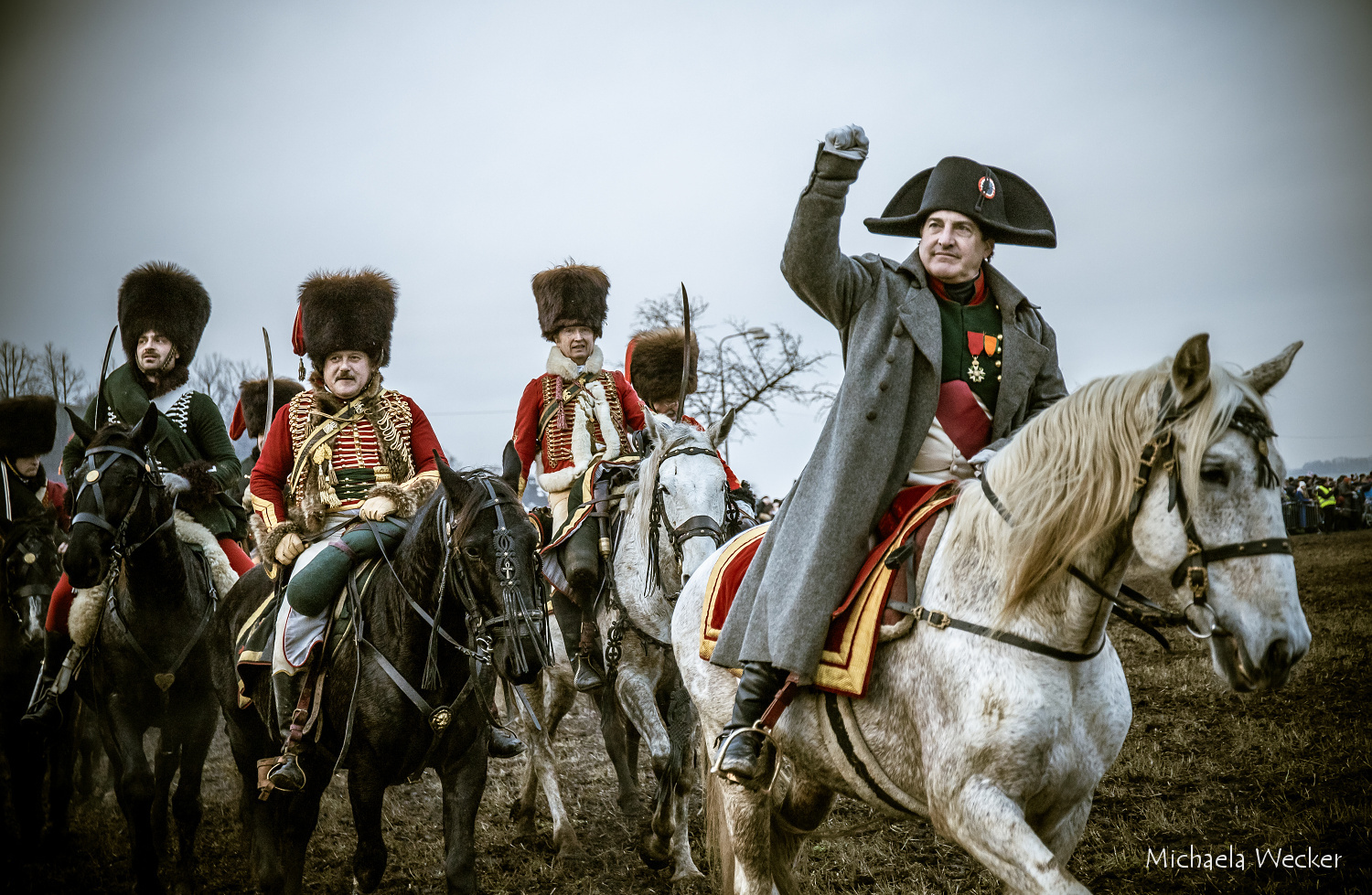
From November 26 to December 2, the Austerlitz 2025 commemorative event dedicated to the 220th anniversary of the Battle of Three Emperors at Austerlitz took place. It was attended by 1,800 reenactors, including 1,600 soldiers armed with 1,100 muskets, 15 cannons, and 95 horses. This made it one of the largest events of its kind in recent years and the second largest Austerlitz event in history, after the 200th anniversary in 2005, which was attended by 3,600 enthusiasts from around the world. The event was also Mark Schneider’s European finale in the role of Napoleon, whom he had successfully and convincingly portrayed for two decades.
The Austerlitz 2025 program kicked off in Kučerov on Wednesday, November 26, in the early evening with a parade and a battle reenactment, loosely inspired by the march of Russian-Austrian forces from Olomouc to Slavkov. On Friday, the official opening took place with traditional fires on Žuráň Hill near the village of Podolí, the place from which Napoleon commanded the first part of the battle in 1805. The fires on Žuráň refer to the night before the battle, when thousands of torches were lit in the French camps and the army paid tribute to their Emperor. Napoleon said that this evening was the most beautiful of his life.
Mark Schneider then spent time in the Russian-Austrian camp on the Tvarožná village green, where he and his staff were invited by the commander of the Russian column to a social gathering. Saturday, November 29, began with a ceremony at Žuráň, where French troops led by Napoleon lined up to watch the famous Austerlitz sunrise. With a slight delay of a few minutes, it actually shone through the low clouds above the Pratzen Heights, creating an atmosphere very similar to that of the morning of December 2, 1805. In the morning, the participants had maneuvers on the future battlefield on their agenda, the purpose of which was to form larger units capable of movement according to the principles of the time.
The French Army consisted of five battalions – one guard and four line battalions with 100 to 160 bayonets, cavalry with 40 sabers and 6 cannons. The Coalition Army consisted of an advance guard and four battalions, including one Russian battalion with a total strength of 450 bayonets, cavalry with 36 sabers and 9 cannons, including a brand new replica of the Austrian 12-pound Liechtenstein field cannon. Participants came from two dozen countries. Most came from the Czech Republic (700) and Poland (250), followed by Germany (200), France (160), Italy (130), Belgium (120), Hungary (50), Slovakia (40), Lithuania (40), Austria, Latvia, Romania, Great Britain, Canada, Ireland, Switzerland, Luxembourg, Spain, Portugal, the United States, and even Argentina.
In the tent behind the podium, Miroslav Jandora, president of the Austerlitz Project, and Pavel Šťastný, mayor of Tvarožná, welcomed the guests of honor, including Jan Grolich, governor of the South Moravian Region, and Stéphane Crouzat, ambassador of the French Republic, who took patronage of the event, senators, deputies, mayors of municipalities through which the armies passed in 1805, and representatives. Mark Schneider also bid farewell to the visitors with his last proclamation after twenty years.
The scenario of the battle reenactment was inspired by the battle fought on December 2, 1805, at Staré Vinohrady. It began with an attack by Vandamme’s French division against General Miloradovich’s Russian infantry, continued with a clash with General Rottermund’s Austrian regiments, and culminated in a clash between the elite corps of both armies, Napoleon’s and Alexander’s guards. All participants survived unscathed, and according to police estimates, 20,000 spectators left satisfied, thanks in part to the exceptionally good weather. According to many veterans, it was one of the most impressive and clearest battle reenactments, which was also appreciated by the cadets of the French military school Saint Cyr and members of the 2nd and 5th Dragoon Regiments of the French Army, units that continue the traditions of the cavalry that fought in the Battle of Austerlitz, who were present. Distinguished members of military history associations were then decorated on the battlefield, and Saturday’s program concluded with a social evening at the Old Post Office in Pozořice, which is the indispensable base and headquarters for the entire event.
On Sunday, the program included partial memorial ceremonies in the villages of the battlefield, and at noon, a memorial ceremony began at the Peace Memorial on the Pratzenberg, the site of the bloodiest clashes of the battle. After speeches by the mayor of Prace, Petr Šimara, and the governor of the South Moravian Region, Jan Grolich, Catholic and Orthodox prayers were said and wreaths were laid in the chapel. Military-historical units paid tribute to the fallen and the deceased and also remembered their own deceased members. Delegations from the 2nd and 5th Dragoon Regiments of the French Army with their standards took part in the memorial ceremony.
As December 2 fell on a Tuesday this year, several dozen participants gathered again on the Žurán and at the Peace Memorial to say their final farewells to Mark Schneider in the role of Napoleon. His last act on European soil was to attend the opening of the new exhibition at the Peace Memorial.
The event was organized as part of the Austerlitz Project by the Central European Napoleonic Society, the municipalities of Tvarožná and Prace, and Austerlitz z.s. The event was produced by AusterlitzPro s.r.o. The program was financially supported by the South Moravian Region and the CzechTourism agency. We would like to thank the other partners of the event, which included Veolia CZ, Explosia a.s., Cairo CZ, and many others. The main media partner of the event was Czech Television.
With greatest pleasure we add the excellent video made by Nibid Atreya (Daniel Lionsberg) for which we are thankful
Austerlitz Grand Re-enactment, 2025
In 2025, the fields beneath the Santon once again echoed with musket fire, galloping hooves, and the disciplined cadence of Napoleonic drill. The annual Austerlitz re-enactment, one of Europe’s premier living-history events, returned on a scale unmatched in recent memory. For viewers familiar with our earlier Austerlitz Animated Documentary, this production brought the same history to life—this time not through animation, but through thousands of reenactors standing on the very ground where the Battle of the Three Emperors unfolded.
AN UNPRECEDENTED MUSTER
Compared to previous years—when approximately one thousand enthusiasts gathered from across Europe—the 2025 commemorative event surpassed all expectations. More than 1,800 participants arrived from over twenty countries, with nearly one hundred horses and sixteen full-sized cannons taking part.
The battlefield below the Santon, traditionally spanning roughly 200 by 250 meters, had been significantly enlarged to an impressive 250 by 400 meters. This expansion allowed for a more authentic tactical representation of early-19th-century manoeuvre warfare.
Behind this colossal undertaking stood a coalition of organizers: the Central European Napoleonic Society, the municipalities of Tvarožná and Prace, Austerlitz z.s., and the production expertise of AusterlitzPro s.r.o. Together they continued the long-standing mission of the Austerlitz Project, now in its thirty-fifth year since Miroslav Jandora first established commemorations at Slavkov.
RECREATING STARÉ VINOHRADY
The scenario for the 2025 re-enactment drew inspiration from one of the most dramatic clashes of the Battle of Austerlitz: the struggle at Staré vinohrady. Historically, Vandamme’s French infantry smashed through General Miloradovich’s Russian division, then pressed on to break Rottermund’s Austrians. What followed was the collision of elite formations—Napoleon’s Guard and the Imperial Guard of Tsar Alexander—before the Russians ultimately withdrew toward Křenovice and Hodonín.
It was the very moment immortalized in François Gérard’s 1810 masterpiece, La Bataille d’Austerlitz, 2 Décembre 1805—a painting the reenactors sought to recreate at the climax of the event.
THE RE-ENACTMENT DEPLOYMENT
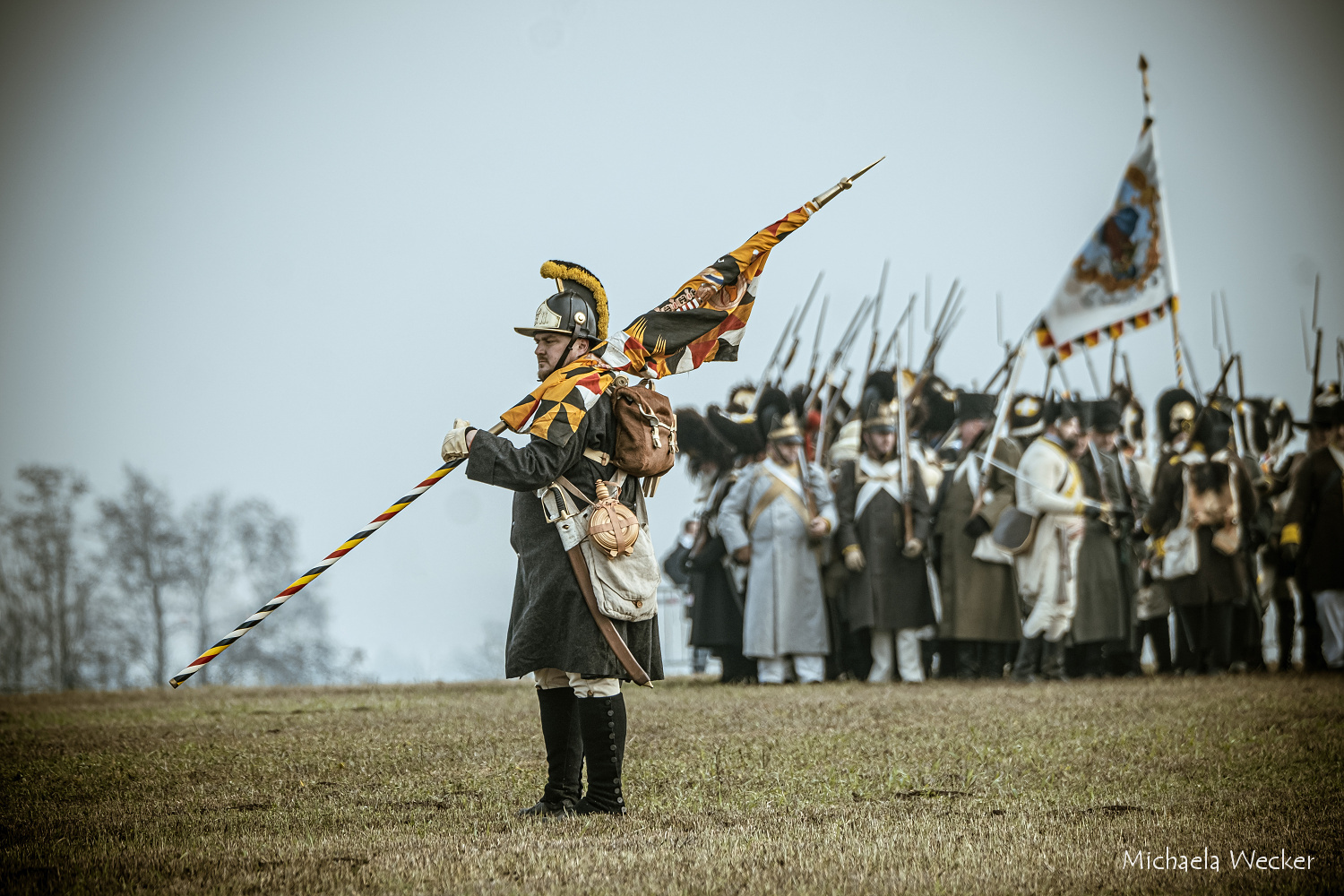
On the day of the re-enactment, 732 reenactors took up arms in the ranks of the Austro-Russian coalition. The infantry was formed from one Russian and three Austrian battalions, while the cavalry brought together Austrian cuirassiers, uhlans, and Russian Cossacks. Supported by artillery, these combined Russo-Austrian forces operated under the capable command of their Commander-in-Chief, Ondřej Tupý.
Opposing them stood the French army. At its forefront was the chivalrous French cavalry, led by the flamboyant Murat, portrayed by Franky Simon. The French infantry comprised four line battalions and a Guard battalion, all supported by artillery and placed under the overall command of the French Commander-in-Chief, Tomáš Doležal. Presiding over the French ranks was the magnificent figure of the Emperor himself, portrayed by the much-respected Mark Schneider, whose presence lifted morale and inspired confidence among both troops and commanders alike.
With 1,097 reenactors on the French side and 732 representing the Austro-Russian coalition, the re-enactment brought together a total of 1,829 troops on the field. For ease of understanding, I have prepared this animation to provide a clear, bird’s-eye view of the events as they unfolded during the re-enactment. This would not have been possible without the extensive support I received from Aneta Matusiewicz, Captain Jakub Samek of the 1st French Infantry Battalion, and Dagmar Živníčková, who portrayed a vivandière during the re-enactment.
THE BATTLE UNFOLDS
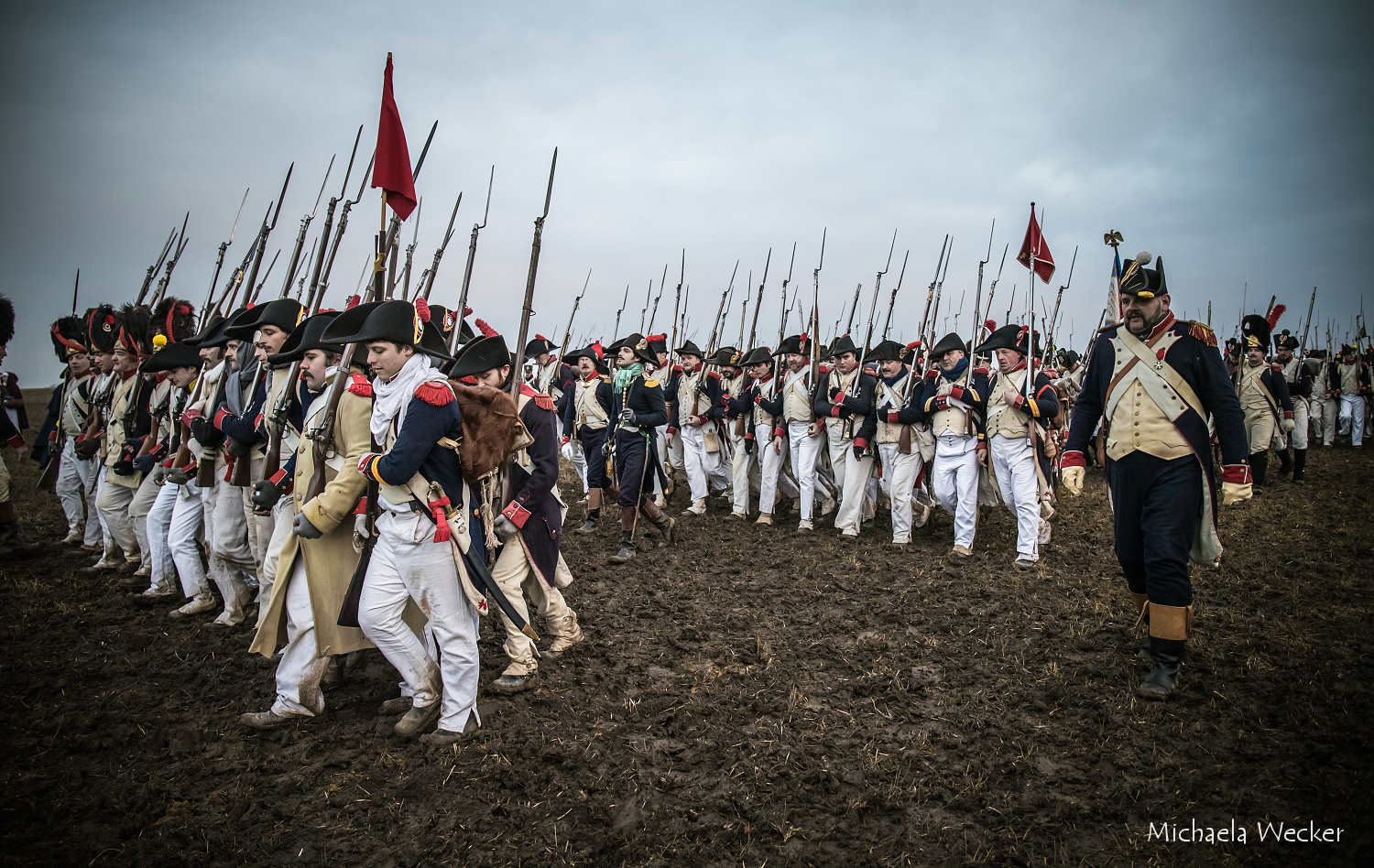
At 14:00, the French began their advance in two lines. The coalition columns deployed into battle formation. Soon, musketry crackled across the entire front. In the cavalry sector, French and coalition horsemen clashed in swirling mêlées of sabers, pistols, and trumpet calls.
By 14:15, the first coalition line—Miloradovich’s division—buckled under French pressure and retreated. The French pressed forward without pause, slamming into Rottermund’s Austrians. Cavalry engagements intensified on the flank.
At 14:30, Rottermund’s line broke. Two battalions and a portion of the artillery retreated toward the southeastern tip of the field. The remaining coalition troops continued firing before the cavalry battle subsided. The French then pulled back behind their lines as coalition cavalry massed to strike the French left.
Three French battalions hastily formed squares—Napoleon’s trusted defensive answer to cavalry. As the last square locked bayonets, the coalition horse charged and shattered the front square. French soldiers fled northwest, closely pursued by enemy cavalry, while the remaining squares fired steadily.
French cavalry regrouped and launched a counter charge, driving the coalition horsemen back toward the south-eastern corner.
By 14:45, the French cavalry formed to attack the “Russian Guard infantry”—one Russian and one Austrian battalion—now standing defiantly in square. Meanwhile, another French battalion advanced into the former cavalry sector, reigniting combat reminiscent of “Lannes versus Bagration.”
At 14:50, French cavalry charged the square before the tribune but were repelled. French infantry advanced to continue the assault.
By 15:00, the remaining Russian and Austrian contingents withdrew either off the battlefield or to the southeastern corner, where isolated fighting persisted.
Then, at 15:05, “Napoleon” rode onto the field with his staff—portrayed for the final time by Mark Schneider. Before the grandstand, reenactors assembled to recreate Gérard’s iconic painting, bringing art and history into living alignment.
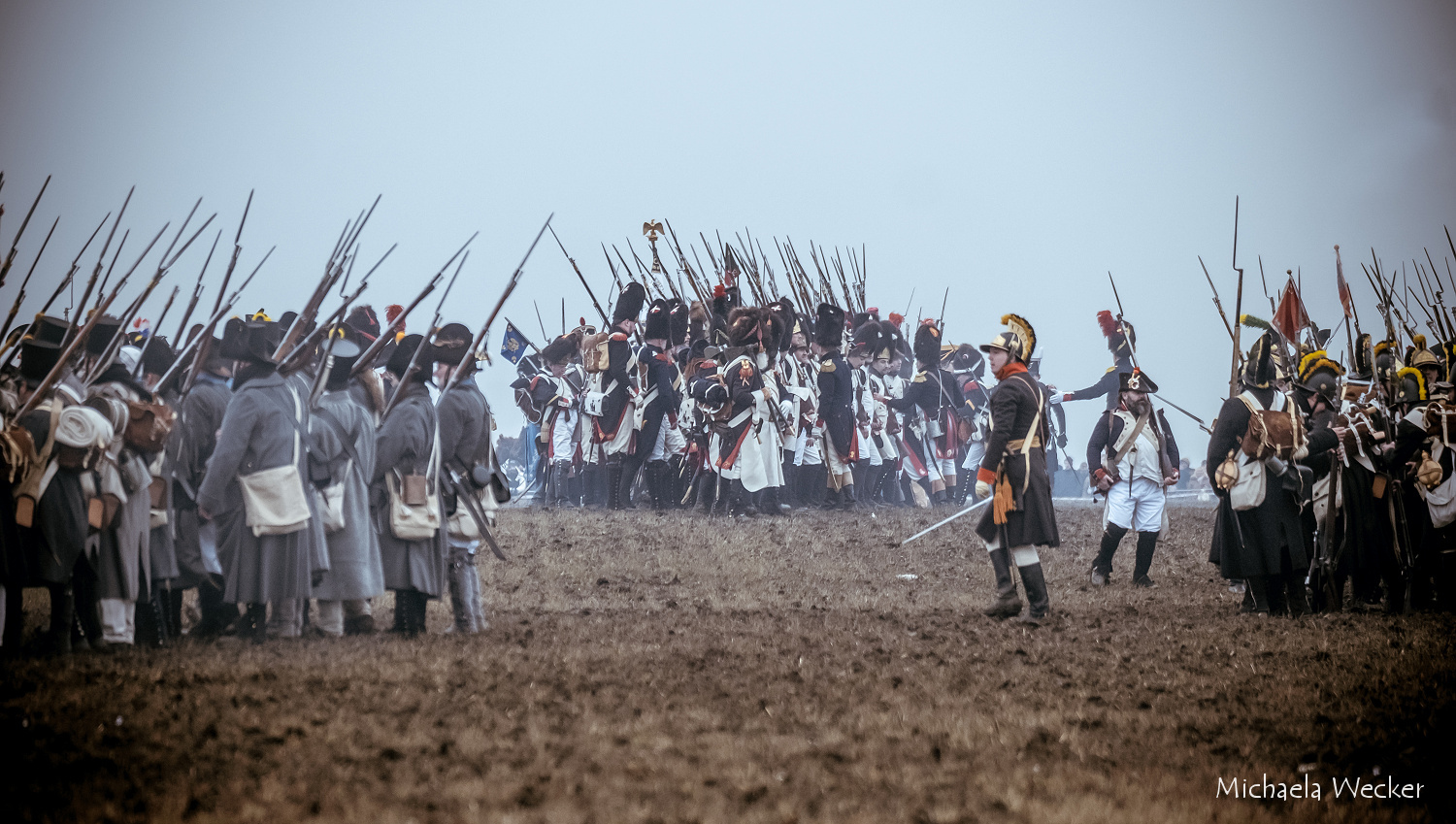
At 15:15, the armies formed one last time for the closing parade. Decorations, promotions, and formal acknowledgments concluded the event, marking the end of an era.
MARK SCHNEIDER’S FINAL SALUTE
Austerlitz 2025 held special significance. It marked the final appearance of Mark Schneider in the role of Napoleon. His first European performances dated back to 2005, during the commemorations of Waterloo and the bicentenary of Austerlitz. For two decades, he brought extraordinary discipline, dignity, and understanding to the imperial role, becoming a fixture at major re-enactments across the continent. He stepped down voluntarily—still able to portray Napoleon with strength and credibility, never as caricature. His farewell at Austerlitz closed a remarkable chapter in re-enactment history.
CONCLUSION
The 2025 Austerlitz re-enactment stood as a tribute not only to the battle itself but to the international community that preserved its memory. With expanded fields, unprecedented participation, and a living recreation of Gérard’s masterpiece, the event honoured 35 years of dedication from the Austerlitz Project and its founder, Miroslav Jandora.
And for viewers of Lionsberg Cinematic History, this documentary now stands alongside our earlier Austerlitz Animated Documentary, continuing our commitment to bringing Napoleonic history to life—through animation, reenactment, and every medium that can keep the past speaking clearly to the present.