Compared to previous years, which attracted around 1,000 enthusiasts from across Europe, we expect 1,800 participants from 20 countries around the world, nearly 100 horses, and 16 cannons. The battlefield area below Santon will be significantly expanded. In normal years, it covers approximately 200 x 250 m, but this year it will be 250 x 400 meters. The event is being organized as part of the Austerlitz Project by the Central European Napoleonic Society, the municipalities of Tvarožná and Prace, and Austerlitz z.s. The event is being produced by AusterlitzPro s.r.o.
The battle reenactment scenario is loosely inspired by the clash at Staré vinohrady, where Vandamme’s French infantry division first defeated and forced the retreat of General Miloradovich’s Russian division, then General Rottermund’s Austrian division, and subsequently, the elite corps of both enemy armies clashed in this area: Napoleon’s and Alexander’s guards. Due to the French numerical superiority, the Russian guard retreated after a short battle towards Křenovice and further to Hodonín. François Gérard also set his painting La bataille d’Austerlitz, 2 Décembre 1805 in 1810 at the end of this clash. At the end of the battle reenactment, the participants will attempt to recreate it.

Outline scenario of the battle reenactment (2:00–3:30 p.m.)
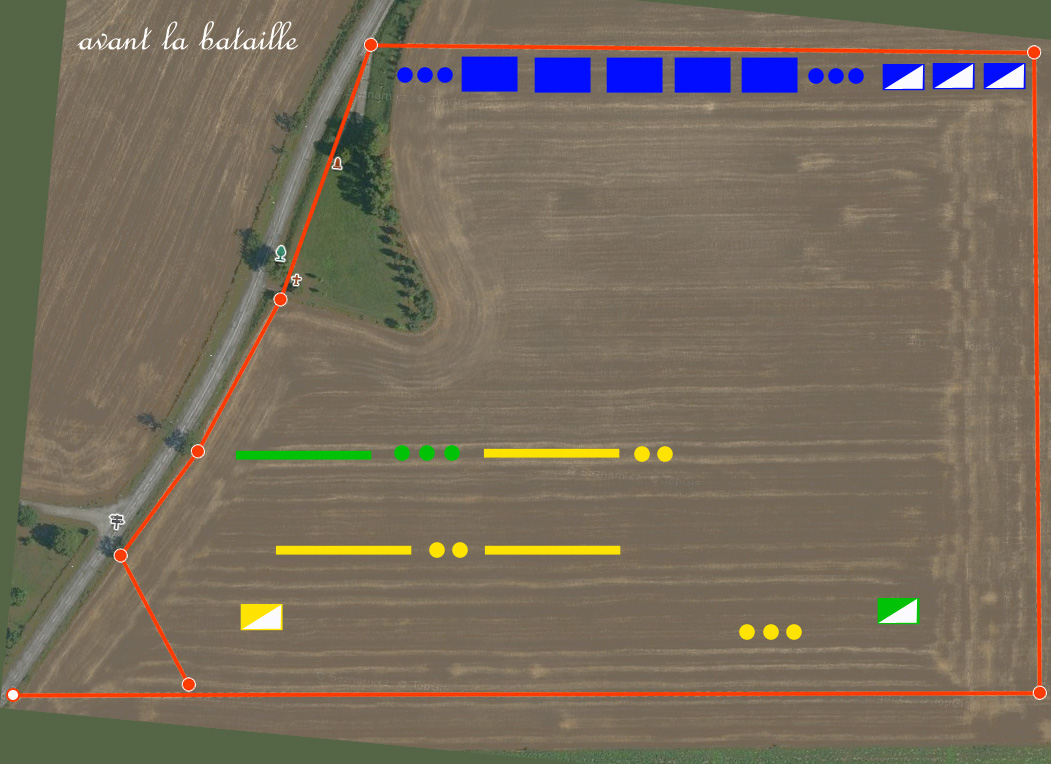
- 14:00 The French begin their maneuver by advancing, forming two lines, deploying the first line—the deployment is covered by skirmishers, who open fire on the coalition columns—the coalition columns move into battle formation and begin fighting; cavalry in the cavalry sector engages in combat (the images are indicative; the execution of each phase includes elements at the discretion of the commanders-in-chief – maneuver, firefight, bayonet fight, encirclements, counterattacks, passing the lines).
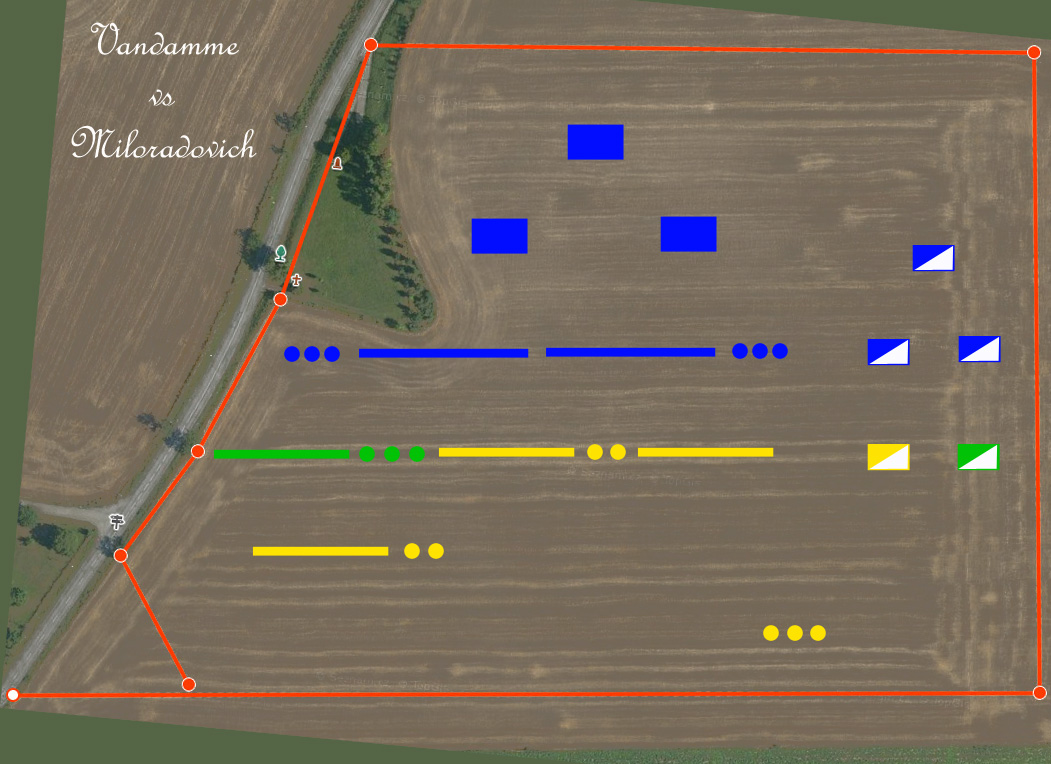
- 14:15 The first coalition line (division Miloradovich) is defeated and retreats, the French advance and engage in combat with the second coalition line (division Rottermund); cavalry continues to fight in the cavalry sector.
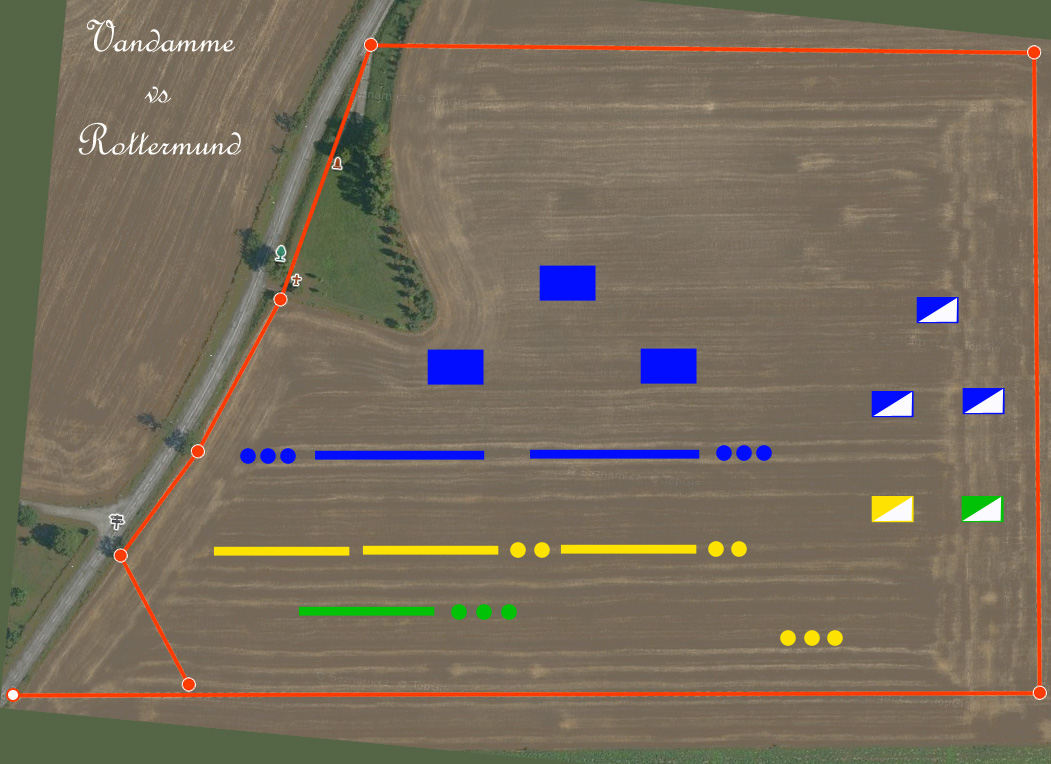
- 14:30 The second coalition line is defeated and two battalions and part of the artillery retreat to the southeastern tip of the battlefield – the remaining forces in front of the grandstand continue firing; subsequently, cavalry combat in the cavalry sector ceases, the French retreat behind the French formation, the coalition cavalry forms up to attack the French left flank – three French battalions form squares – as soon as the squares are formed, the coalition cavalry attacks the front square and breaks it – the soldiers flee to the northwest, the cavalry pursues them; the remaining two squares continue firing.
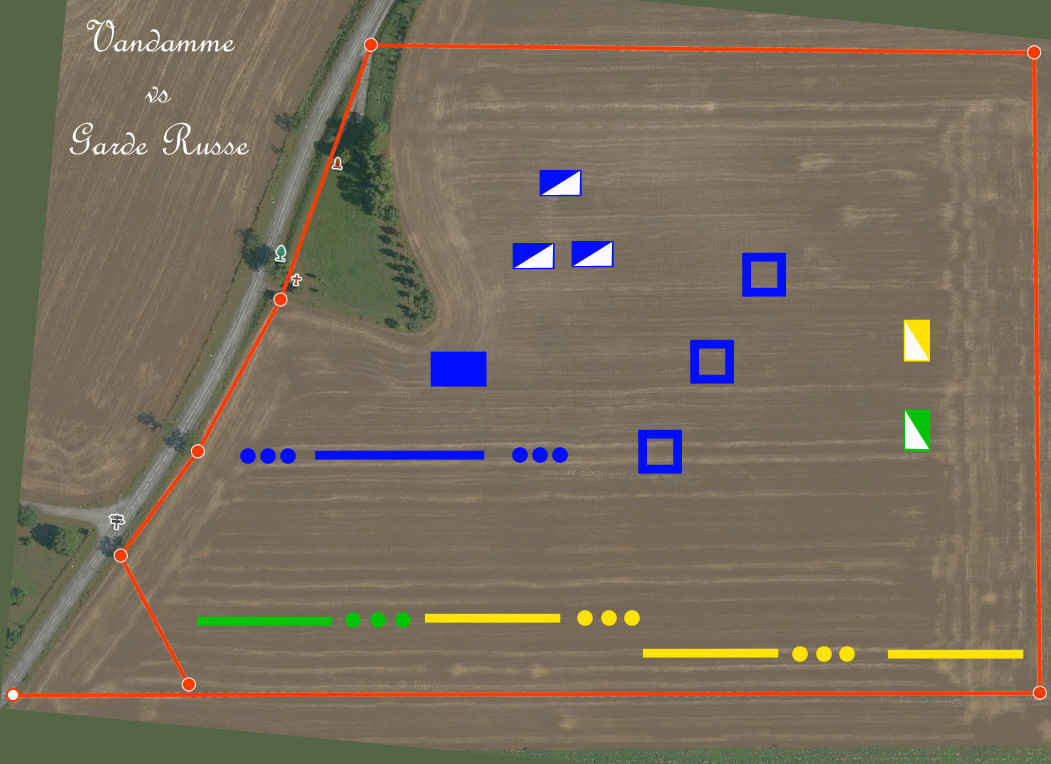
- 14:40 French cavalry countercharge repells the coalition cavalry to the southeast corner.
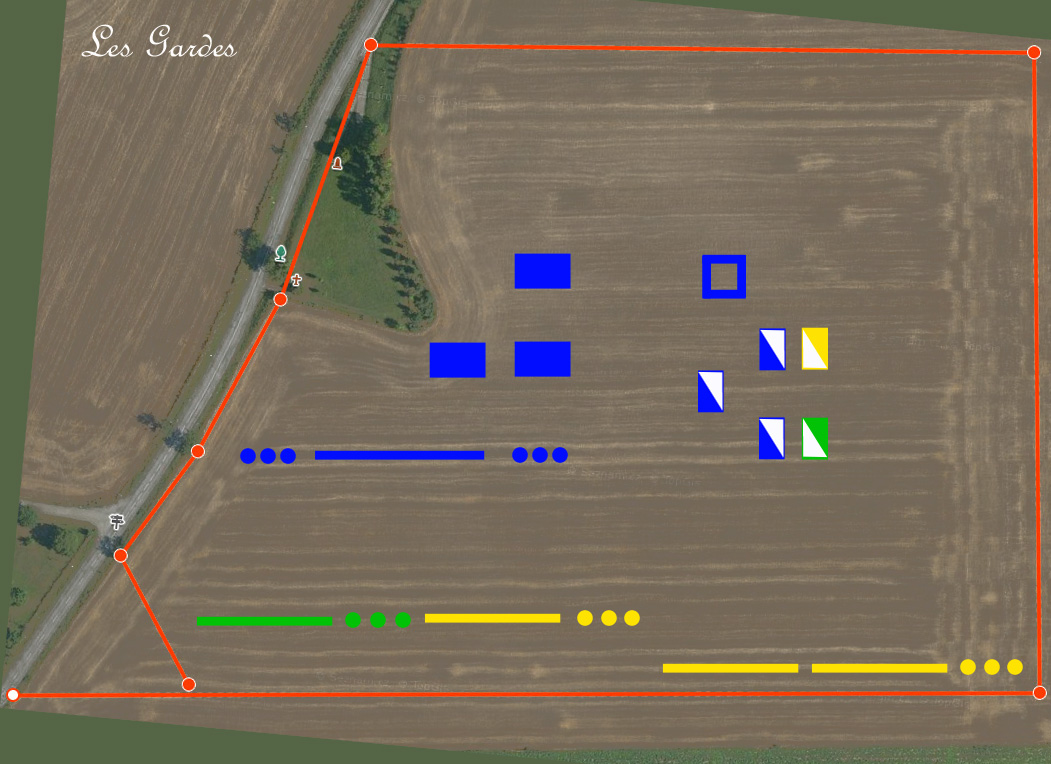
- 14:45 French cavalry forms up to attack the “Russian guard infantry” (one Russian and one Austrian battalion), infantry forms squares. One French battalion advances against Austrian infantry and cavalry in the former cavalry sector, where fighting continues (“Lannes vs Bagration”).
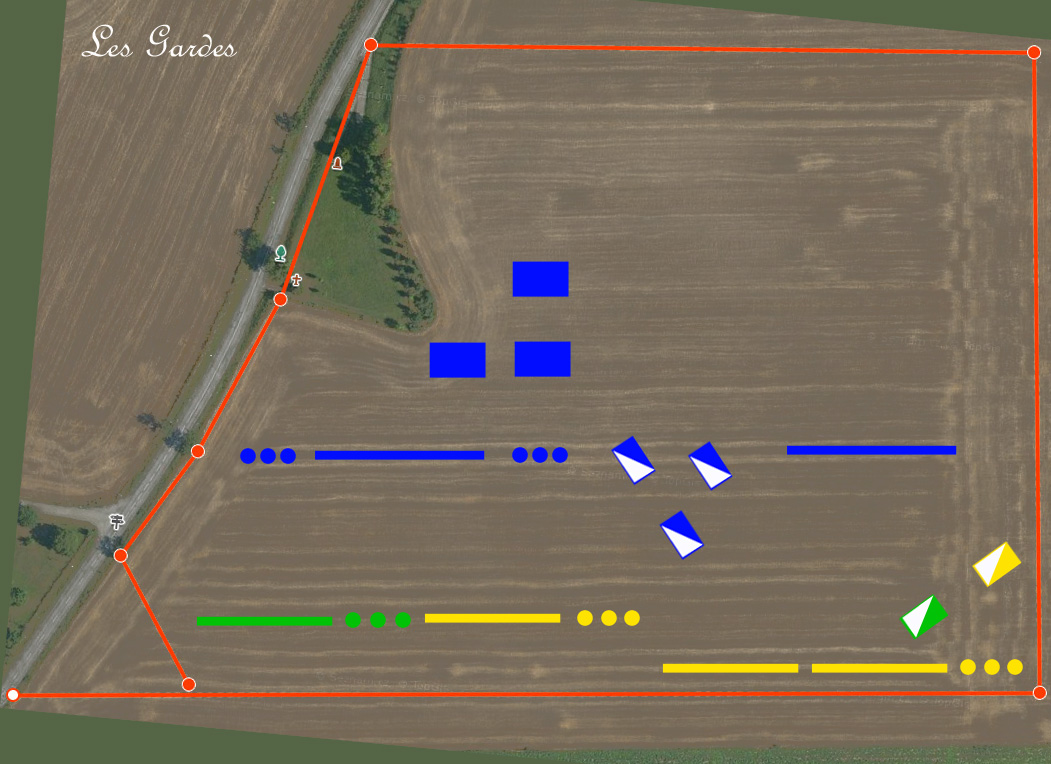
- 14:50 French cavalry attacks the square in front of the tribune, but is repelled and retreats; French infantry takes over the attack.
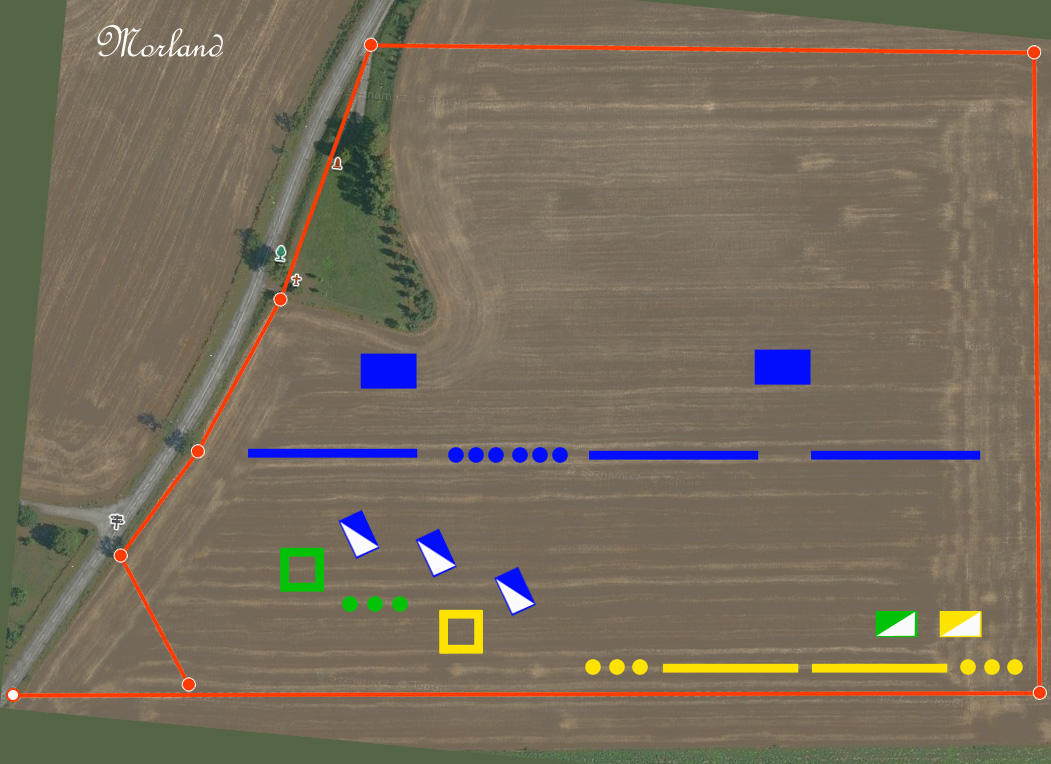
- 15:00 The remaining Russian and Austrian forces retreat off the battlefield and/or to the southeastern tip of the battlefield, where fighting continues (“Lannes vs. Bagration”).
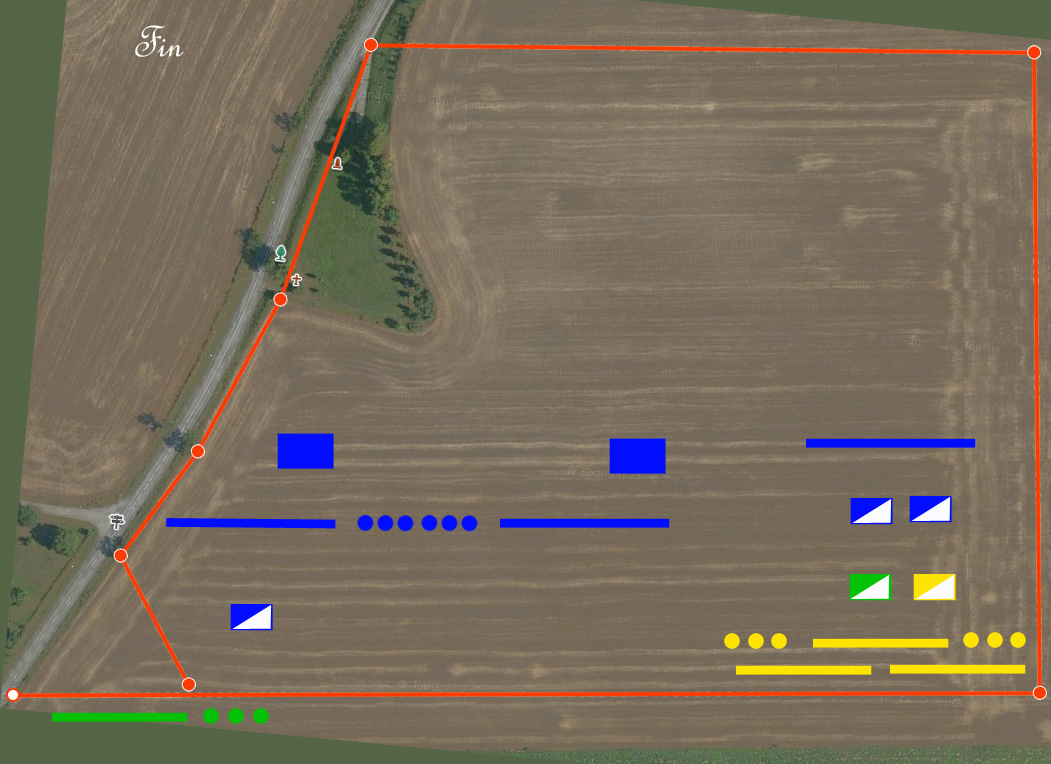
- 15:05 Napoleon arrives in front of the tribune with his staff, live painting of La Bataille d’Austerlitz by Gérard
- 15:15 Units form up for the parade, parade, promotions, decorations, end of event
The Austerlitz 2025 event is Mark Schneider’s last appearance in the role of Napoleon. Mark began his “imperial career” on the European continent in 2005 with events at Waterloo and Slavkov (200th anniversary of Austerlitz 2005), and over the next two decades he participated in all major programs throughout Europe. He has been a regular guest at Austerlitz events. He is leaving the role voluntarily and at the height of his powers, at a time when he is still able to portray Napoleon in a way that is not a caricature. The Austerlitz 2025 event will mark 35 years since Miroslav Jandora, president of the Austerlitz Project and main organizer of commemorative events for the Battle of the Three Emperors, organized the first commemorative event at Slavkov.
Order of Battle of the French Grande Armée (predominant uniform color: blue)
Grande Armée
- Sa Majesté l’Empereur et Roi… Mark Schneider
- Le Ministre de la guerre, major général, expédiant les ordres de Sa Majesté… David Paget
- S.A.S. le prince Murat, lieutenant de l’Empereur… Franky Simon
- Grand maréchal du Palais… Andrea Puleo
2e Division d’infanterie du 4e corps… Tomáš Doležal, général de brigade
Bataillon de la Garde Impériale… Pavel Grenar, lieutenant
- Grenadiers à pied, Petr Košťál
- 1er Grenadiers à pied, Jean-Marie Essique
- 1er Grenadiers à pied, Philippe Bézanger
- 1er Grenadiers à pied, Gilles Morel
- 1er Chasseurs à pied, Cuomo Thierry
- 1er Chasseurs à pied, Quentin Istace
- 2e Chasseurs à pied, Joseph Fogacci
- 2e Chasseurs à pied, Claude Biefnot
- Fusiliers-grenadiers, Jiří Vašíček
- 1er Tirailleurs-Grenadiers de la Garde, Milan Potluka
- Marins de la Garde, Jaroslav Janúšek
- Marins de la Garde Imperiale, Rainer Pönicke
1er Bataillon d’infanterie… Jakub Samek, capitaine
- 8e de Ligne, Jaroslav Vašík
- 8e de Ligne, Jean Yves Rouzé
- 18e de ligne, Petr Davidik
- 18e de Ligne, Michal Lukšíček
- 30e de ligne, Petr Krejčí
- 37e de ligne, Walter Rocher
- 48e de Ligne, Jhonny Delahaye
- 51e de ligne, Carlo Alberto Ghigliotto
- 57e de Ligne, Renné Ragas
- 67e de Ligne, Jean-Michel Roget
- 129e de Ligne, Ignas Babušis
2e Bataillon d’infanterie… Nicolas Salvetat, lieutenant
- 3e Légère, Krzysztof Polak
- 16e Légère, Jean-Louis Dutel
- Légion irlandaise, François Casanova
- 4e de Ligne, Philippe Roucoux
- 6e de Ligne, Achille Verschoren
- 18e de Ligne, Tomáš Konečný
- 18e de Ligne, Raphael Maion
- 18e de Ligne, Nicolas Salvetat
- 22e de Ligne, Oliver Schmidt
- 33e de Ligne, Martin Beck
- 85e de Ligne, Sean van Hese
- 108e de Ligne, Benjamin Moro
- 3ème demi brigade Helvétique, Liniger Hervé
3e Bataillon d’infanterie… Fabio Ronchi, capitaine
- 1er Légère, Sergio Ferronato
- 9e Légère, Gernot Döhne-Jochmann
- 11e Légère, Ilicio Quattrocchi
- 1° Leggero, Trione Alessandro
- 3e de Ligne, Vicente F. Santana Gimenez
- 18e de Ligne, Frank Biedenweg
- 108e de Ligne, Giorgio GREMESE
- 113e de Ligne, Antonio Gremese
4e Bataillon d’infanterie… Adam Uszyński, chef de bataillon
- 2 PPXW, Adam Uszyński
- 4 PPXW, Pawel Chodoruk
- 7 PPXW, Grzegorz Stój
- 8 PPXW, Jerzy Nowicki
- 12 PPXW, Piotr Zawada
- Legia Polsko-Włoska, Krzysztof Poźniak
- Legia Polsko-Włoska, Marek Gniewek
- Legia Polsko-Włoska, Radoslav Matusiewicz
- Legia Polsko-Włoska, Kamil Misiak
- 3e Regiment de la Vistule, Jacek Borowski
Division d’artillerie… Petr Rozsypak, capitaine
- 5e Artillerie à pied, Petr Rozsypal
- 6e Artillerie à pied, Radek Pažízek
- 7e Artillerie à pied, Petr Žampach
- 8e Artillerie à pied, Wolfgang Müller
- Artillerie à pied de la Garde, Jiří Kareš
Cavalerie de la Garde Impériale… Jean-François Rémy-Néris, capitaine
- Chasseurs à cheval de la Garde, Jean-François Rémy-Néris
- Dragons de la Garde, Robert Drábek
Cavalerie du Grand Duché de Varsovie… Maciek Zapaśnik, capitaine
- Pułk 2 Ułanów XW, Maciej Zapaśnik
Order of Battle of the russo-austrian army (predominant color of uniforms: green and white)
Avantgarde – k. k. Unterlieutenant Ondřej Král
- k. k. Jäger-Bataillon Nr. 1, Ondřej Král
- k. k. Jäger-Bataillon Nr. 10, Jaromír Sedláček
- Tyroler Jägercompagnie, Norman Rätsch
Grenadier-Bataillon „Kaunitz“ – k. k. Major Lubomír Partyka
- k. k. LIR Kaunitz Nr. 20, 1ste Grenadier-Compagnie, Lubomír Partyka
- k. k. LIR Kaiser Nr. 1, Tomáš Hrdina
- k. k. LIR Erzherzog Ferdinand Nr. 2, Martin Šiatkovský
- k. k. LIR. Jordis Nr. 59, Robert Müller
Combiniertes-Bataillon „Erzherzog Carl“ – k. k. Oberlieutenant Wolfgang Lachnit
- k. k. LIR Erzherzog Carl Nr. 3, Wolfgang Lachnit
- k. k. LIR Hohenlohe-Bartenstein Nr. 26, Massimo Zanca
- Chufürstliche sächsische Regiment „Churfürst“, Martin Klemmt
Füsilier-Bataillon – k. k. Oberlieutenant Jiří Konečný
- k. k. LIR Kaunitz Nr. 20, Oberst-Compagnie, Jiří Konečný
- k. k. LIR Klebeck Nr. 14, Leonardo Danieli
- k. k. Olmützer-Landwehr-Bataillon, Miroslav Mlčuch
- k. k. LIR Kollowrat Nr. 36, Jiří Bureš
- k. k. LIR. St. Julien Nr. 61, Hunor Pop
- k. k. LIR Erzherzog Franz Carl Nr. 52, Barna Bodai
- k. k. LIR Deutschmeister Nr. 4, Landwehr-Bataillon, Jan Hodina
Artillerie-Brigade – k. k. Unterlieutenant Martin Dopita, k. k. Unterlieutenant István Antal
- k. k. FAR 4 „Monarch“, Pavel Ondráček
- k. k. FAR 4 „Waitz“, István Antal
- k. k. FAR 1 „Dobruschka“, Aleš Prostředník
- k. k. FAR 4 „Jauernig“, Martin Dopita
- k. k. FAR 1 „Colloredo-Mansfeld“, Radek Faigl
- Regiments-Artillerie der k. k. LIR Nr. 1 & k. k. LIR Nr. 2, Pavel Král
Cavallerie-Brigade – k. k. Rittmeister Zdeněk Ševčík
- k. k. CR Kaiser Nr. 1, Vlastimil Šmach
- k. k. CR Modena Nr. 2, Nikolaus Schmid
- k. k. UR Merveldt Nr. 1, Zdeněk Ševčík